»This isn’t class struggle rhetoric, it’s class struggle in practice«
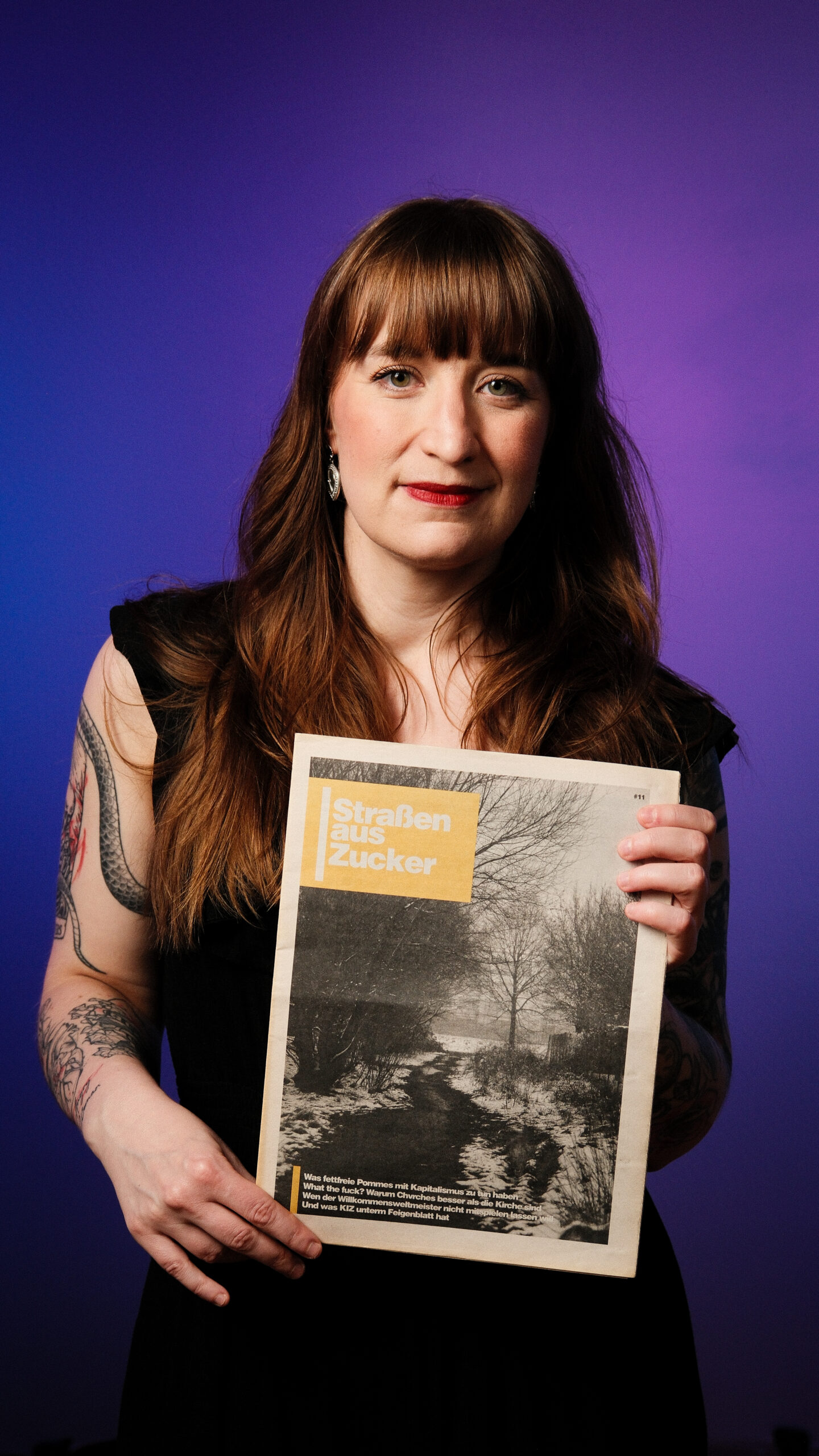
Heidi Reichinnek is a politician and has represented the Left Party in the Bundestag since 2021; she has been the parliamentary group leader since 2025. As well as being a Middle East scholar, she is an internet sensation: Over 1.5 million people follow her on Instagram and TikTok, where she regularly comments on political debates and issues.
Streets of Sugar: Heidi, this edition is all about contradiction and doubt. We’re asking about the potential that lies in not resolving apparent contradictions, but allowing them to coexist. We’re looking for nuances, third perspectives and practising constructive doubt. Streets of Sugar isn’t known for being a great fan of party politics. Nevertheless, we asked you for an interview – after all, we too want to practise enduring contradictions. All the more reason to be delighted you’re joining us.
What value do contradictions hold for you? What do you gain from contradictions?
Heidi Reichinnek: For me, contradictions are a way of reflecting on my own thoughts and ideas and gaining new insights. Of course, as with any debate, there needs to be a framework within which these contradictions can take place. But then they have an indispensable value not only for further development, but also for consolidating one’s own position.
What role do doubts play for you?
I think it’s good to doubt yourself every now and then, rather than assuming that you already know and can do everything anyway. That’s also linked to humility and the ability to recognise there’s always room for improvement and further development.
Are there any contradictions between you as a private individual and you as a politician?
The biggest contradiction is probably that, as a private individual, I don’t like being in the spotlight at all – I’d much rather just read a book somewhere in peace and spend time with the people who are particularly important to me. In politics, you always have to be visible, always stand your ground, be combative. I can do that, but it would be nice if you could attract attention with the better argument rather than with the most sensational headline.
Have you ever had encounters or conversations with people whose attitudes or statements initially made you feel defensive, only for you to realise afterwards: ‘Wait a minute, there’s something to that – I’m taking something from this’?’
I’ve always tried to approach people in a way where I first listen to their opinions and beliefs, and try to understand how they came to hold them and how that developed. Basically, it always makes sense to factor this into your own thinking.
You’re successful on TikTok and Instagram with left-wing politics, but aren’t these platforms, with their algorithms and short-form content, actually the opposite of what we need for nuanced politics?
It’s one of many ways to connect with people, to strike up a conversation and present your own views. I think it’s crucial that what you say is based on facts and that you can back it up, so that people can look it up for themselves. And that you don’t just identify problems, but – in particular – also present solutions. For me, that’s actually the key point.
Just how diverse is the content you actually watch on social media? Do you ever make a conscious effort to break through the algorithm and diversify the content you’re shown?
Of course, I’m faced with the same algorithms as the rest of you. As soon as you watch two or three videos on a topic, your feed is suddenly full of similar content. I have my political account, but I also have a private one, which is naturally tailored to my personal interests. But I don’t go out of my way to monitor the opposition or deliberately look at what’s happening in other bubbles. Otherwise, you lose yourself in it all too quickly.
How much ambiguity and contradiction can – and should – a left-wing party tolerate?
We are a party, not a sect, and therefore it’s important to discuss matters amongst ourselves and not take everything for granted, but rather to have processes in place that allow us to continually re-evaluate our own positions. The world is constantly evolving, and that’s why it’s also a strength of political parties that they engage in sometimes heated debates. I would like to see these controversial internal discussions not always being portrayed from the outside as drama, because how else are we supposed to make progress if not by discussing things with one another? And, of course, issues on which there is broad consensus hardly feature in the debates. That’s actually quite a shame, because often these are precisely the core issues we want to prioritise.
Which positions within your party do you personally have reservations about?
Naturally, I don’t agree with my party one hundred per cent – that’s not even possible, and it’s perfectly fine that way. As a politician, however, I represent the party’s manifesto. That’s the basis on which I was elected, just like everyone else, and I stick to it.
Let’s be honest: do you believe in the revolution, or have you long made peace with reforms within the system? How revolutionary can you be if you’re part of the parliamentary system?
I agree with Rosa Luxemburg – we need the revolution to change the status quo, but on the way towards it we must do everything possible to improve people’s lives. Ultimately, though, that sounds easier than it is. We must never rest on reforms; the goal remains to shape the economic system so that it serves the people. And that means everyone, not just a small, wealthy class. Unfortunately, we’re currently a long way from that. And if anyone complains again: no, this isn’t class struggle rhetoric. This is class struggle in practice.
As a leftist in a parliament led by the Christian Democratic CDU/CSU and the Social Democratic Party SPD, how much opposition do you have to put up with? And how do you cope with it?
For me, the biggest contradiction is the constant claim that they want to ease the burden on people, to do something for children, pensioners, workers – pick any group you like – and then things just get worse. Because they supposedly have to make cuts, because there’s no money, because the spending cap is holy and the super-rich are untouchable. I hear this every day and it makes me so incredibly angry. Every important goal – climate protection, inclusion, integration; again, everyone can pick their own example – is sacrificed because nobody apart from us is raising the issues of distribution and property. Yet I see committed people in all the democratic parties; I find myself wondering – how do they put up with it?